- For how many days should we stay?
Only one or a couple of nights can be a pleasure in the Bale Mountains if you are planning on staying at the Dinsho lodge or in Goba and making day trips to enjoy the sights and splendours of the park. For foot and horse trekkers, anywhere from 1 or more nights can be spent in the mountains. If you have enough time, then spending every night in a each of the eight wilderness camps makes for a wonderful journey, in which case the trek will last for 8 nights and 9 days. The minimum should be two days with one night spent in a wilderness camp of your choice. Alternatively you can stay in the Dinsho lodge for the duration of your visit in the park and make day trips to different corners of the park.
- How much experience in horse riding is necessary?
Many of our visitors have never ridden a horse before and come back highly satisfied with their newly acquired skills. It takes only minutes to learn the essentials for being able to let oneself be carried by a horse. Trotting and galloping can be avoided to make you feel safe. Otherwise you can still opt for walking which is just as fast as riding but rather more tiring. For groups it is a practical option to take fewer horses than there are members for some to walk and some to ride alternatively.
- Do the guides speak foreign languages?
The guides speak good English as a foreign language well enough to be able to communicate with you. Some basic knowledge of English is required on your side.
- Can we go for a mountain trip on our own without guide?
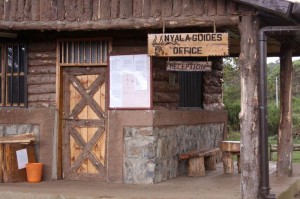
Nyla Guides Reception
Even if you buy our trekking map and have a GPS with you for navigation it is not possible to set out on a trek without a guide (nor is it recommended). Security is not a problem; however, hiring of a guide from Nyala Guides Associations is compulsory. The role of the guide is to guide and help visitors interact with assistants and local people (who do not all speak English), see to the improvement of their services, sort out with them eventual complaints and cater as much as possible for any unforeseen needs.
- Will we see wild animals?
The Bale Mountains are home to a variety of wild animals and sightings of many of these species (the endemic mountain nyala, Ethiopian wolf, Menelik's bushbuck and many more) are virtually guaranteed. If you are lucky there is a possibility of spotting leopard, lion, wild dog and Bale monkey in the Harenna forest.
- Can children handle traveling in BMNP?
Traveling with children in the Bale Mountains can be a rewarding experience for both parents and children. Trekking itineraries can easily be adapted for a child’s endurance and interests. They can experience the wilderness of the Bale Mountains from atop a gentle, child-friendly horse, with or without a guide to lead the horse.
A recent visitor to Bale had this to share about his experience: “I visited Bale Mountains National Park with my mother (70 years old) and my two kids (six and eight years old). We had a lovely trek spending one night on the massif camping. The vistas and landscape in Bale are staggering and we were lucky enough to see a number of wolves. The whole Bale ecosystem is a special place and very interesting to visit. Kids will take lessons back to the schoolroom about the environment and the world around them.”
- How soon do we have to make bookings?
The facilities and guides are used to full capacity during the peak seasons of Christmas and Easter. At all other times booking is not really required. If you arrive impromptu in Dinsho during the afternoon all arrangements can be made for the next day.
- What kind of eating places are there in Dinsho town?
There are several local restaurants in Dinsho offering the standard range of Ethiopian dishes at a very low price. Otherwise come prepared to cook your own food at campsite at the BMNP headquarters. Bottled water can be purchased in the shops in town.
- Where can I buy firewood?
Please be aware that almost all firewood on sale in and around the Bale Mountains National Park comes from slow-growing native trees (juniper & Hagenia) that are threatened by unsustainable exploitation. Land covered by native woodland is decreasing at an ever-increasing rate, directly endangering local biological diversity.
During your stay in the Bale Mountains National Park, both at the headquarters and while camping, we ask that you do not buy firewood locally and that you do not collect, or ask anyone to collect on your behalf, firewood from inside the National Park. Eucalyptus should be the only firewood used. Sustainable firewood can be purchased at the park headquarters from the Walin Jirana Wood Sellers Association at the park entrance gate; for Rira and the Harenna forest firewood can be obtained at cost price (not for profit) at the Bale Mountain Lodge.
- Where can I buy socially and environmentally responsible crafts?
The Barre Women’s Handicraft Association was established in 2010 by six women skilled in craft production, with an aim to create economic empowerment of women based on their skills. Subsequently, traditional craft production has become another important source of income for women to support their households.
The majority of the population of the Bale Mountains is dependent upon harvesting precious natural resources of the area to sustain their families. By supporting the Barre Women’s Handicraft Association, you can help to diversify income-generating livelihoods and in turn help to reduce pressure on the natural resources of the area. Furthermore, this greatly contributes to the empowerment of women in an otherwise male- dominated society.
The establishment of the Barre Women’s Handicraft Association resulted from a movement to increase the participation of women in the ongoing tourism development and conservation of the Bale Mountains National Park. The Frankfurt Zoological Society facilitated the establishment of the association by building a craft shop within the park where the women can sell their goods, as well as providing training in several areas including developing environmentally friendly and marketable products for visitors to the park.
The Barre women produce various baskets for local markets as a way to generate income. However, with the exception of wedding season, there is not much of a market for these baskets in the Bale area. Their handicrafts are available for sale at the entrance gate to the park headquarters.
- How much do I tip?
For taxi, bajaj or gari drivers, it is best to agree on a price in advance. Tips are not mandatory but 5 birr is appreciated. Keep in mind that money goes a lot further in rural areas.
For guides in the national park, if you feel that their service was satisfactory, a tip is appreciated. If you feel that they’ve gone above and beyond feel free tip more generously. The amount of the tip should depend both on the level of service and on the number of days they have spent with you. A rough guideline is anywhere from 10 to 40 percent.
However, please do not hand out things such as money, empty water bottles, pens or other objects, as this will encourage begging.